

The Night Manolo Tried to Cook for Forty People: A Kitchen Disaster
Experiences Worth Living
The bet happened on a Tuesday in October 1963, right after Agustín bragged that he could outdo anyone in the kitchen. Manolo was three glasses into a bottle of Albariño with his cousin Ramón when he declared that cooking disasters only happened to people who didn't plan properly.
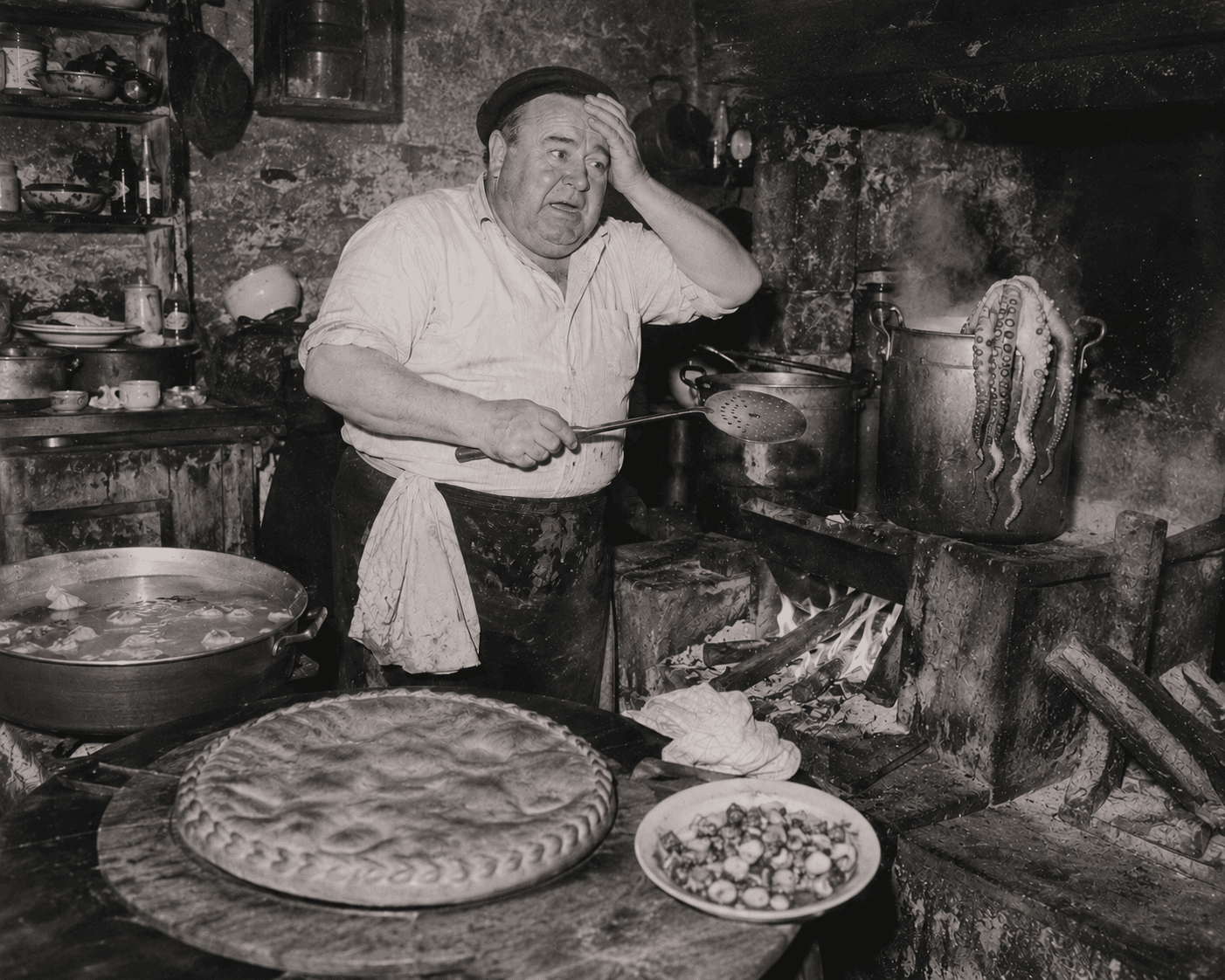
Manolo lost the bet spectacularly, but we all won a story that only gets better with time.
The Bet
From the journal of Agustín: October 1963
It was a Tuesday, and I had been talking too much again...three glasses of my own Albariño will do that to a man.
Manolo and his cousin Ramón were at the corner table, the one with the wobbly leg that nobody has fixed since before the war, and Manolo was holding forth on the subject of kitchen disasters. He had opinions (he always has opinions). This particular opinion was that cooking disasters only happen to people who don't plan properly, which is the sort of thing a man says when he has never cooked for more than four people in his life.
I should have let it pass. I know this now. But the wine was good, the evening was warm, and Manolo's confidence was sitting there like a fat pigeon on a fence post, just begging to be startled.
"Prove it," I said. "Cook for the whole village at Saturday's harvest celebration."
Ramón nearly choked. The entire café went silent, that particular silence that falls over a room when everyone realizes they are about to witness something magnificent or catastrophic, and possibly both. Then someone started laughing. I have my suspicions it was Tomás, who has nursed a grudge against Manolo since an incident involving a borrowed fishing net in 1957 that neither of them will fully explain. But the laughter spread, and by the time it stopped, Manolo had agreed. He had no choice. A man cannot back down from a bet in this village and expect to show his face at cards ever again.
By Thursday, the entire village knew. Forty people to feed, and hundreds of volunteers at the ready. Manolo's ridiculous promise. I confess I felt a small tiny pang of guilt, the way one does when setting a trap for a rabbit and then seeing the rabbit walk directly into it with enthusiasm.
Thursday: The Shopping List of Doom
Esperanza, God bless her practical soul, handed Manolo a list longer than his arm. Forty servings of pulpo a la gallega. Caldo gallego for the vegetarians, all three of them, who I could name but won't because Mercedes becomes agitated when people call attention to it. Empanada gallega large enough to feed a small army. And chestnuts, because someone (must have been old Pilar) insisted they be roasted in the traditional way, the way we've always done it in Galicia, with fire and smoke and at least one minor burn.
Manolo stared at this culinary suicide note for a long time. Rosa, who runs the village store and has a talent for making bad situations worse with arithmetic, calculated how much octopus forty people could reasonably consume. "Two kilos," she announced with the cheerfulness of a woman who does not have to cook it. "Maybe three, if Carmen brings her appetite." Carmen, who was sitting right there, said nothing, but her expression suggested Rosa might find a dead fish in her mailbox.
I gifted Manolo four kilos of octopus. I told myself it was generosity. In truth, it was fuel for the fire. Four kilos. The man's eyes went wide. He looked at the octopus the way a condemned man looks at the gallows, with a kind of horrified respect. By Thursday evening, his kitchen looked as though a seafood market had suffered a nervous breakdown. Tentacles on the counter. Potatoes in the sink. A bag of chestnuts spilling across the floor that the cat was batting around with great joy. The smell was extraordinary, and not in the way poets mean when they use that word.
Ramón stopped by, surveyed the chaos with the calm assessment of a man who has no intention of helping, and immediately volunteered to be "emergency backup." This, as anyone in the village could have predicted, meant stealing a bottle of wine from my cellar...the good Mencía, which I was saving...while offering commentary of no practical value whatsoever. "You should have started the broth yesterday," he said, pouring himself a glass with my wine, in Manolo's house. "Everyone knows that."
I let him have the wine. It was worth it for the gossip he brought to our card game that night. Manolo had already burned the first batch of onions, argued with Esperanza about the correct thickness of empanada dough, and been bitten by the octopus. Not a live octopus, mind you. A dead one. He cut his hand on it somehow. Only Manolo!
I sat at the card table, listened to Ramón's account, and dealt the hand. Saturday was going to be magnificent.
I was not wrong.
Saturday Morning: The Great Empanada Rebellion
Manolo started the empanada dough at six in the morning. Six. I know this because Ramón told me, and Ramón knew because he was sleeping on Manolo's sofa after finishing my Mencía the night before and was woken by the sound of a man arguing with flour.
Manolo had his grandmother's recipe, the one she wrote on the back of a feed store receipt in 1931, the one that has never failed a soul in that family, and he was confident. Foolishly, catastrophically confident.
His grandmother, God rest her, never tried to make enough empanada for forty people at once. This is an important distinction that Manolo understood fully by seven o'clock, when the first batch had stuck to everything...his hands, the counter, and, through some act of physics no one has been able to explain, the ceiling. The second batch refused to rise at all. It sat there on the board like a pancake with delusions of grandeur, flat and pale and looking up at him with what Ramón described as contempt.
By nine, Manolo had flour in his hair, dough packed under every fingernail, and a kitchen that looked as though someone had detonated a bomb inside a bakery. The cat had retreated to the top of the wardrobe and was watching him with an expression of deep concern.
That is when Esperanza arrived. She did not come alone. She brought reinforcements: her mother-in-law Carmen, a woman who has been making empanada since before the Republic and who has no patience for amateurs. Carmen took one look at the disaster, at the dough on the ceiling and the flour in Manolo's eyebrows, and started laughing so hard she had to sit down on the stool by the door. She laughed until she wheezed. She laughed until tears ran down her face.
"Mijo," she said, when she could finally speak, "you are supposed to knead the dough, not declare war on it."
Then she rolled up her sleeves, pushed him aside with the authority of a general taking command of a lost battle, and saved his dignity.
The Caldo Gallego Catastrophe
While Carmen performed her miracle with the empanada, Manolo turned his attention to the caldo gallego, reasoning that soup (soup!) was surely the safest option available to a man of his limited talents. He was wrong. He was wrong in ways I did not know a person could be wrong about soup.
The beans, which should have been soaking since Thursday, were still hard enough to use as ammunition. I know this because Ramón brought one to the café as evidence. It bounced off the counter like a marble. The grelos, the turnip greens that had looked so beautiful at the market, so green and full of promise, turned into a bitter mush the instant they touched the water. And somewhere in his panic, in the fog of a man who has lost control of every dish simultaneously, Manolo added salt three separate times. That broth could have preserved meat for winter. Small fish might have died in it.
He was desperately adding water to dilute this catastrophe, which only produced a larger quantity of disaster, a kind of salty dishwater that no amount of potato could rescue, when Tomás appeared in the doorway. Tomás, who started the laughter on Tuesday night. Tomás, who has been waiting for this moment since I opened my mouth and challenged Manolo in the first place.
"This reminds me of the Great Soup War of '58," he announced, leaning against the doorframe with the satisfaction of a man whose day has exceeded all expectations. "Except that was actually edible."
Even Manolo's cooking disasters had critics.
Salvation Arrives (With Wine and Laughter)
By noon, half the village had materialized in Manolo's kitchen. I want to be clear: they did not come to help. They came to witness. There is a difference, and it is measured in the amount of wine consumed by people who are standing around watching someone fail.
Rosa brought her famous tetilla cheese as, in her words, "emergency backup food," which was both kind and devastating. I arrived with three bottles of Ribeiro "for courage" and because a man should look his victim in the eye when the bet is nearly won. Even Father Miguel appeared, claiming he had come to bless the food, though he spent considerably more time blessing the wine and laughing at Manolo than performing any spiritual duties.
And then, I do not know exactly when it happened, or how, the disaster transformed into something else entirely.
It was somewhere between Carmen's empanada coming out of the oven golden and perfect, and Rosa slicing her cheese onto a board, and someone opening the second bottle. Somewhere between Ramón finally making himself useful by carrying the table outside, and old Pilar arriving with a basket of chestnuts and the iron pan she's had since before anyone can remember. Somewhere between Father Miguel's third glass and Tomás admitting, grudgingly, that the octopus smelled extraordinary.
The octopus. The four kilos I had gifted Manolo to add to his panic, somehow, miraculously, against all odds and his own incompetence, was tender. It was delicious. He cut it on the wooden board with the pimentón and the oil and the coarse salt, and people went quiet the way they do when food is genuinely good, that silence that is worth more than any compliment. I will admit, though only here in this notebook where no one will read it: I was proud of him.
Carmen's empanada was perfect. Rosa's cheese made everyone forget about the soup, which was quietly removed and never spoken of again. The wines of Galicia flowed freely: the Albariño first, then the Ribeiro, then a Mencía that someone produced from somewhere, and by evening our whole village was around the table and people were calling it the best harvest celebration in years.
Manolo lost the bet. Spectacularly, completely, without question. But he won something better: a story that gets funnier every time someone tells it. And we all know a good story is worth more than pride.